Our website has moved to its new home at http://www.haitianalysis.com

News, analysis, and archives on the grassroots in Haiti. Nouvèl, analiz, ak achiv sou baz yo an AYITI. Noticias, análisis y archivos sobre el pueblo de Haití.
Friday, January 11, 2019

Wednesday, December 19, 2018
U.S. must pay reparations to survivors of 1000's of victims of George HW Bush's 1989 invasion of Panama
By Grahame Russell - Rights Action
"To allow any of them to pass into the comfort of forgetting would be utterly obscene."
-Lawrence Thornton, Imagining Argentina

Around midnight, December 19, 1989, the U.S. unleashed a massive “shock and awe” invasion of Panama, attacking from the air, the water and on land. 1000s of Panamanians civilians were killed within days; many more wounded. Entire neighborhoods were razed to the ground.
On October 5, 2018, the Inter-American Commission on Human Rights ruled that: “the United States of America … provide full reparation for the human rights violations established in [this] report, including both the material and moral dimensions; Adopt measures that provide both financial compensation and satisfaction.”
· Jose Isabel Salas & others v. United States – Report No. 121/18, Case 10.573: http://www.oas.org/en/iachr/decisions/2018/USPU10573-EN.pdf
(In late December, 1989, at a place called the Garden of Peace, the U.S. military dumped 123 Panamanian bodies of Operation Just Cause invasion victims into a common grave; they did not bother to identify the cadavers, or advise the family members. CODEHUCA “This is the just cause” report, 1990)
U.S. Owes Reparations to Panama over Bush’s Invasion
For close to 30 years, the Center for Constitutional Rights has been representing Panamanian survivors of the December 19, 1989, U.S. invasion of Panama, in an on-going struggle for a measure of justice and reparations for 1000s of people killed, many more wounded, plus untold amounts of destruction.
"To allow any of them to pass into the comfort of forgetting would be utterly obscene."
-Lawrence Thornton, Imagining Argentina
Around midnight, December 19, 1989, the U.S. unleashed a massive “shock and awe” invasion of Panama, attacking from the air, the water and on land. 1000s of Panamanians civilians were killed within days; many more wounded. Entire neighborhoods were razed to the ground.
On October 5, 2018, the Inter-American Commission on Human Rights ruled that: “the United States of America … provide full reparation for the human rights violations established in [this] report, including both the material and moral dimensions; Adopt measures that provide both financial compensation and satisfaction.”
· Jose Isabel Salas & others v. United States – Report No. 121/18, Case 10.573: http://www.oas.org/en/iachr/decisions/2018/USPU10573-EN.pdf
(In late December, 1989, at a place called the Garden of Peace, the U.S. military dumped 123 Panamanian bodies of Operation Just Cause invasion victims into a common grave; they did not bother to identify the cadavers, or advise the family members. CODEHUCA “This is the just cause” report, 1990)
U.S. Owes Reparations to Panama over Bush’s Invasion
For close to 30 years, the Center for Constitutional Rights has been representing Panamanian survivors of the December 19, 1989, U.S. invasion of Panama, in an on-going struggle for a measure of justice and reparations for 1000s of people killed, many more wounded, plus untold amounts of destruction.
Tuesday, December 18, 2018
The Dominican Republic's Political Scene and the road to 2020
[Note from the editors: The HaitiAnalysis collective is happy to announce the relaunching of our site at our original domain http://www.haitianalysis.com. We will continue to update this blogspot page for the time being, but in the future only the main domain will be updated. We are happy to announce that we will be relaunching the publication of original material, with a few new articles every month. We will also be expanding our coverage to include the Dominican Republic . Please stay tuned for big things! Below is a new analytical piece providing an overview of the Dominican Republic's political scene and the author's views on where political events are headed in that country.]
By: Ariel Fornari - HaitiAnalysis
By: Ariel Fornari - HaitiAnalysis
The ruling PLD's internal struggles and the 2020 elections
Over recent weeks and months the possible re-election of President Danilo Medina has sparked a plethora of internal conflicts within the ruling PLD (Partido de la Liberacion Dominicana). President Medina’s appointed officials belonging to the “sector externo”, insist that he run for a second re-election, but the majority of these “sector externo” officials, are not even members or heirs of the party’s founding nucleus, which Professor Juan Bosch founded in 1973 as an ideologically progressive collective, after leaving the historical PRD (Partido Revolucionario Dominicano) earlier that year.[1]
It’s noteworthy that in Santiago, D. R.’s second most important city with a population of over one million, officials holding high positions such as the municipal water company’s director are not even from Santiago, also belong to the “sector externo” of Medina. This in turn is generating the current tug-of-war, with Santiago’s mayor Abel Martinez, who happens to belong to (ex-President) Leonel Fernandez’s faction within the PLD.
 |
| Ex-President Leonel Fernandez aiming for a political comeback |
Santiago's mayor Abel Martinez is an avowed "nationalist" with anti-Haitian leanings, when as president of the D. R.’s lower house he stubbornly confronted in 2013 the visiting Inter-American Commission on Human Rights, which was on a fact finding mission regarding D. R.’s Constitutional Tribunal’s Ruling 168-13. The ruling had denationalized over 200,000 Dominicans of Haitian descent, causing much international backlash over the racist policies. As proof of his unwavering loyalty towards Fernandez, Martinez held a large and extravagant rally for Fernandez’s presidential candidacy, at a Santiago sports stadium on December 9, 2018. Some Dominican media are speculating that Martinez aspires to be Vice-President on the 2020 electoral ticket with Fernandez.
Regarding the Medina re-election issue, if no agreement is reached between Medina and Fernandez, the re-election issue becomes moot, opening the door to other PLD leaders via a national winner-take-all convention. In this scenario, the winner is anointed at the convention and Fernandez would be a major contender, while Medina as sitting president couldn’t throw his hat in the ring, due to the obvious re-election constitutional issue, currently limiting a sitting president to a second consecutive term. Medina’s re-election ambitions could only materialize, under another constitutional amendment by the legislative branch, obviating the PLD’s convention scenario, and like President Balaguer remarked many times: “The Dominican Constitution is a mere piece of paper”. What has been done to the D. R.’s Constitution in recent times resembles more of a Saturday Night Live skit than the high level proceedings of a law abiding nation-state.
We must bear in mind, Medina presently holds in his pocket the majority of the PLD’s lower house deputies, key players in constitutional amendments. Furthermore, there are some PRSC (Partido Reformista Social Cristiano-a smaller right-wing party currently allied with the PLD) deputies, whose position would support a constitutional amendment, contingent on a mutual agreement with Medina. In this case, the Dominican folksy character of “the man with the briefcase”, would make his colorful entrance into this skit. To the unenlightened on Dominican rough and tumble politics, this translates to a designated courier, carrying a “maletin” or briefcase stuffed with sufficient wads of hard currency, to bribe enough deputies, adding to this Mafiosi-like script, mutual agreements between Medina and complicit deputies, so the latter could also be re-elected with attending perks as applicable.
Friday, November 23, 2018
Wednesday, November 21, 2018
Kevin Pina and Pierre LaBossiere on PHTK massacres in Cité Soleil and La Saline

Listen here to an interview (on KPFA's Flashpoints Radio) with documentarian Kevin Pina and Haiti Action Committee founder Pierre LaBossiere, as they discuss the recent anti-corruption protests in Haiti and the brutal repression launched by the country's rightwing authorities.
Tuesday, November 20, 2018
Hold the U.S./U.N. Occupation Accountable
The United Nations, along with the United States and Canada, trains and supervises the murderous Haitian police and oversees Haiti’s horrendous prisons where beatings, torture and killings are routine. Condemn the police killings of demonstrators in Haiti by the UN-supervised police and attaches
and demand an end to the US/UN occupation.
Contact U.N. representative in Haiti, Sophie Boutaud de la Combe: e-mail: boutauddelacombes@un.org; Twitter: @SBDLC @MINUJUSTH
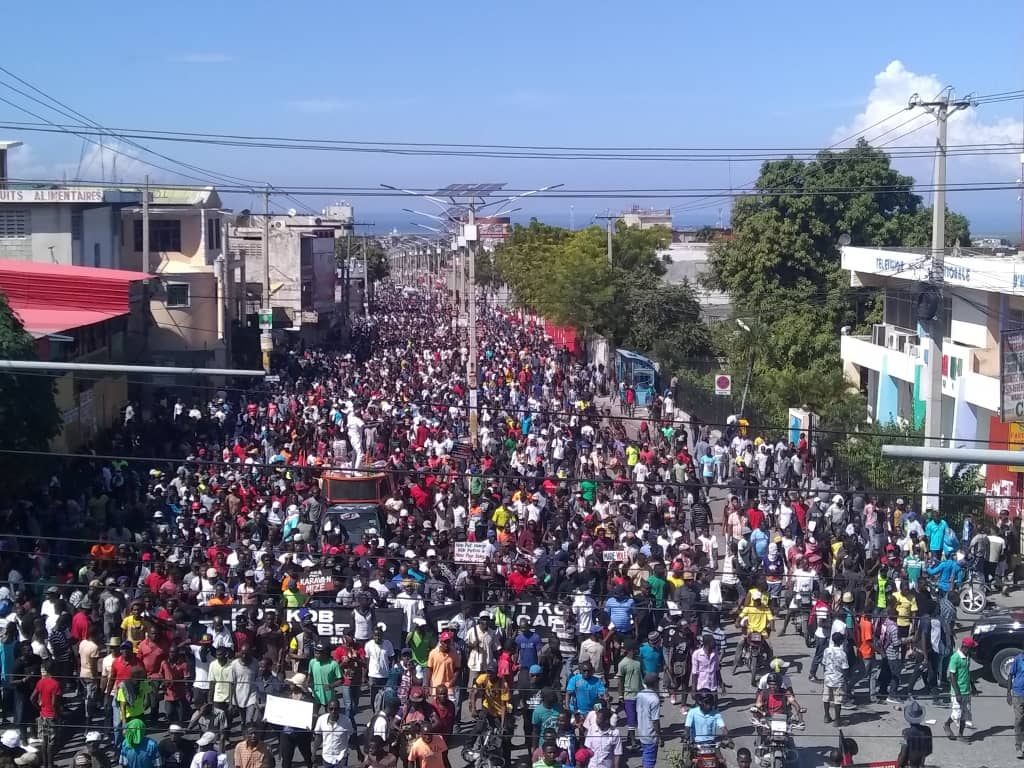 Sunday November 18, 2018, was the 215th anniversary of the victory at the battle of Vertieres when Haitians won a decisive battle against French forces in 1803, leading to the declaration of Haitian independence. People all over Haiti marked the occasion with massive protests against the theft of billions of dollars of Petrocaribe funds provided to the Haitian government by Venezuela. The demonstrators continued their call for the end to the murderous UN/US occupation and the imposed, illegitimate government of president Jovenel Moise and prime minister Jean-Henri Ceant.
According to radio and witness reports the police have been shooting at unarmed protestors, wounding and killing an undetermined number. The situation on the ground in Haiti has been worsening as the Moise regime, backed by the U.S. and the UN, has ramped up a savage campaign of repression against the population. In the Port-au-Prince area alone, the list of attacks includes the police killing of a student leader on 10/31/18, the shootings during the week of 11/5/18 of teachers and high school students in Site Soley (Cite Soleil) protesting months of non-payment of overdue salaries and the lack of educational supplies, the mass killings and land-grab expulsion in Kanaan (Canaan) and the massacres on November 13  and 17, 2018 in the community of Lasalin (La Saline).
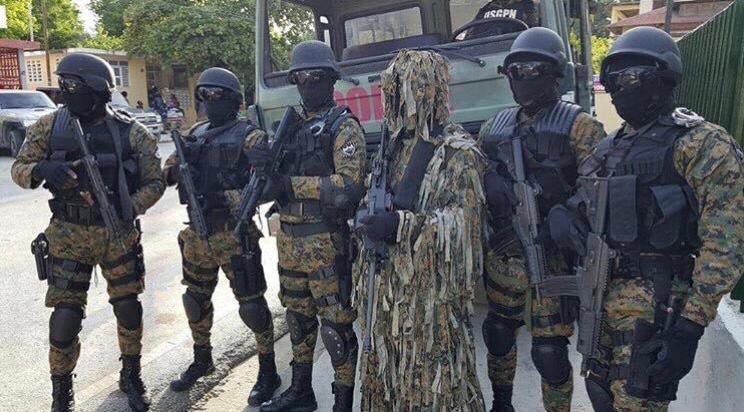 and 17, 2018 in the community of Lasalin (La Saline).
Please read the Fanmi Lavalas statement condemning the 11/13 horrible massacre in Lasalin which occurred during the commemoration of another government organized massacre in Granravin (Grand Ravine) on 11/13/17, one year ago to the day. The statement in Kreyol https://tinyurl.com/ydg87mh8 can also be heard over a graphic video from Haitiinfoproj showing some of the victims. The death toll varies as reports from witnesses are being assessed; many were disappeared, bodies were also reportedly burned and trucked away.
We support and stand in solidarity with our sisters and brothers in Haiti as they refuse to accept dictatorship and terror. Support and stand in solidarity with our sisters and brothers on the ground in Haiti! They are unarmed and bravely taking on the US/UN-supported killers, the UN-trained police and their paramilitary attaches or affiliates.
Thursday, November 15, 2018


The PetroCaribe Scandal and its Historical Precedents
Catherine Charlemagne - Haiti Liberte
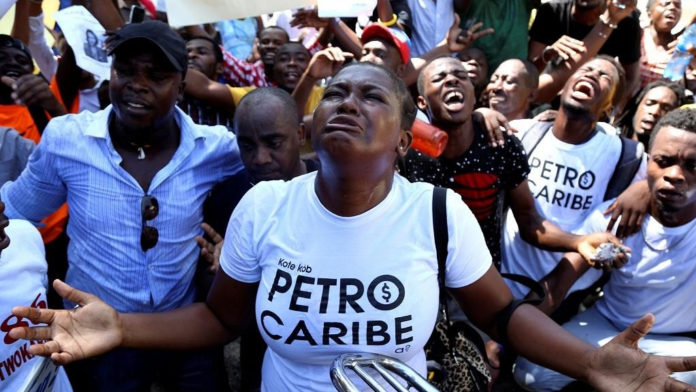 History will likely record the Oct. 17, 2018 demonstration as the real beginning of this PetroCaribe uprising.
Clearly, the PetroCaribe affair is gaining momentum. With every passing day, Haitian society becomes more engrossed with this scandal which exposes the outrageous conduct of our leaders vis-à-vis public funds.
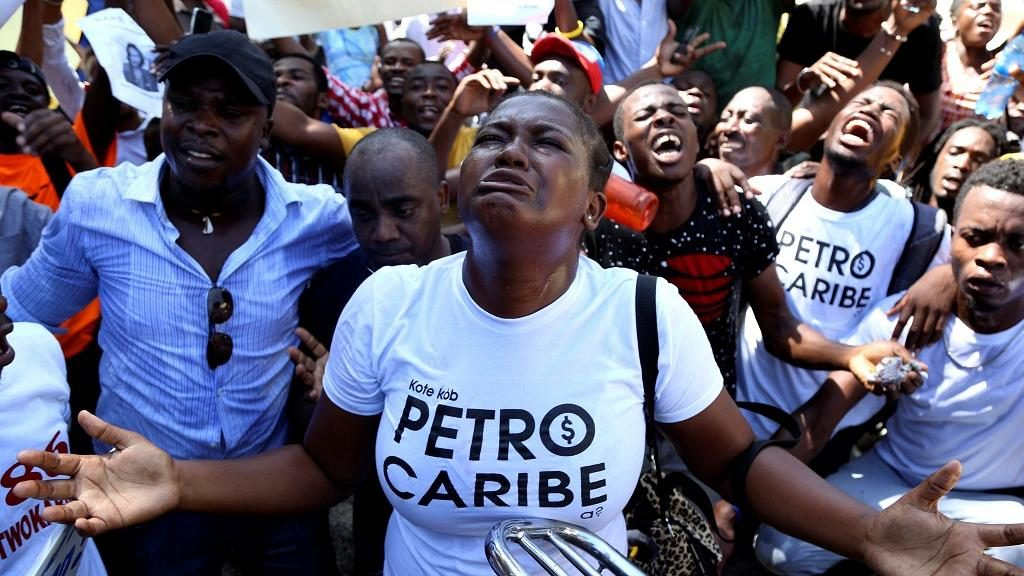 History will likely record the Oct. 17, 2018 demonstration as the real beginning of this PetroCaribe uprising.
 Clearly, the PetroCaribe affair is gaining momentum. With every passing day, Haitian society becomes more engrossed with this scandal which exposes the outrageous conduct of our leaders vis-à-vis public funds.
Thursday, November 8, 2018
UniFA: Reduce neonatal mortality in Haiti!
The University of the Aristide Foundation (UniFA)
Our fundraising goal is $3,000, to include 20 NeoNatalie resuscitation simulator kits ($86), 20 resuscitation bags and suction devices ($25), and teaching flipcharts and workbooks ($304), plus shipping. CLICK HERE: https://ubackforgood.com/donor/…
The Helping Babies Breathe curriculum is being brought to UNIFA in order to provide neonatal resuscitation training to medical and nursing students.

Volunteers (including Certified Trainers) are working with Friends of UNIFA to bring this American Academy of Pediatrics program to UNIFA.
Our fundraising goal is $3,000, to include 20 NeoNatalie resuscitation simulator kits ($86), 20 resuscitation bags and suction devices ($25), and teaching flipcharts and workbooks ($304), plus shipping. CLICK HERE: https://ubackforgood.com/donor/…
The Helping Babies Breathe curriculum is being brought to UNIFA in order to provide neonatal resuscitation training to medical and nursing students.

Volunteers (including Certified Trainers) are working with Friends of UNIFA to bring this American Academy of Pediatrics program to UNIFA.
Tear-Gassing of Belair Funeral Provokes Outrage
Kim Ives - Haiti Liberte
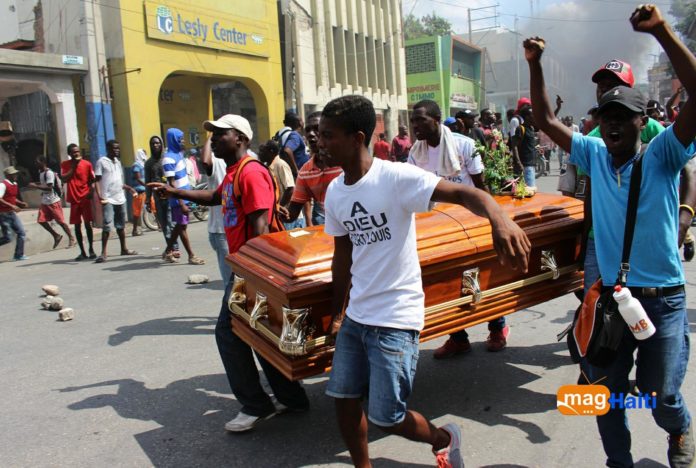 When it was learned that at least two people were killed by police bullets outside the church, the mourners marched with the caskets down the hill to the center of town.
On Oct. 31, hundreds of mourners gathered at Our Lady of Perpetual Help church in Port-au-Prince’s Belair neighborhood for the funeral of six of the seven protestors killed by police during the massive Oct. 17 march against the plundering of hundreds of millions of dollars from the Venezuela-provided PetroCaribe fund.
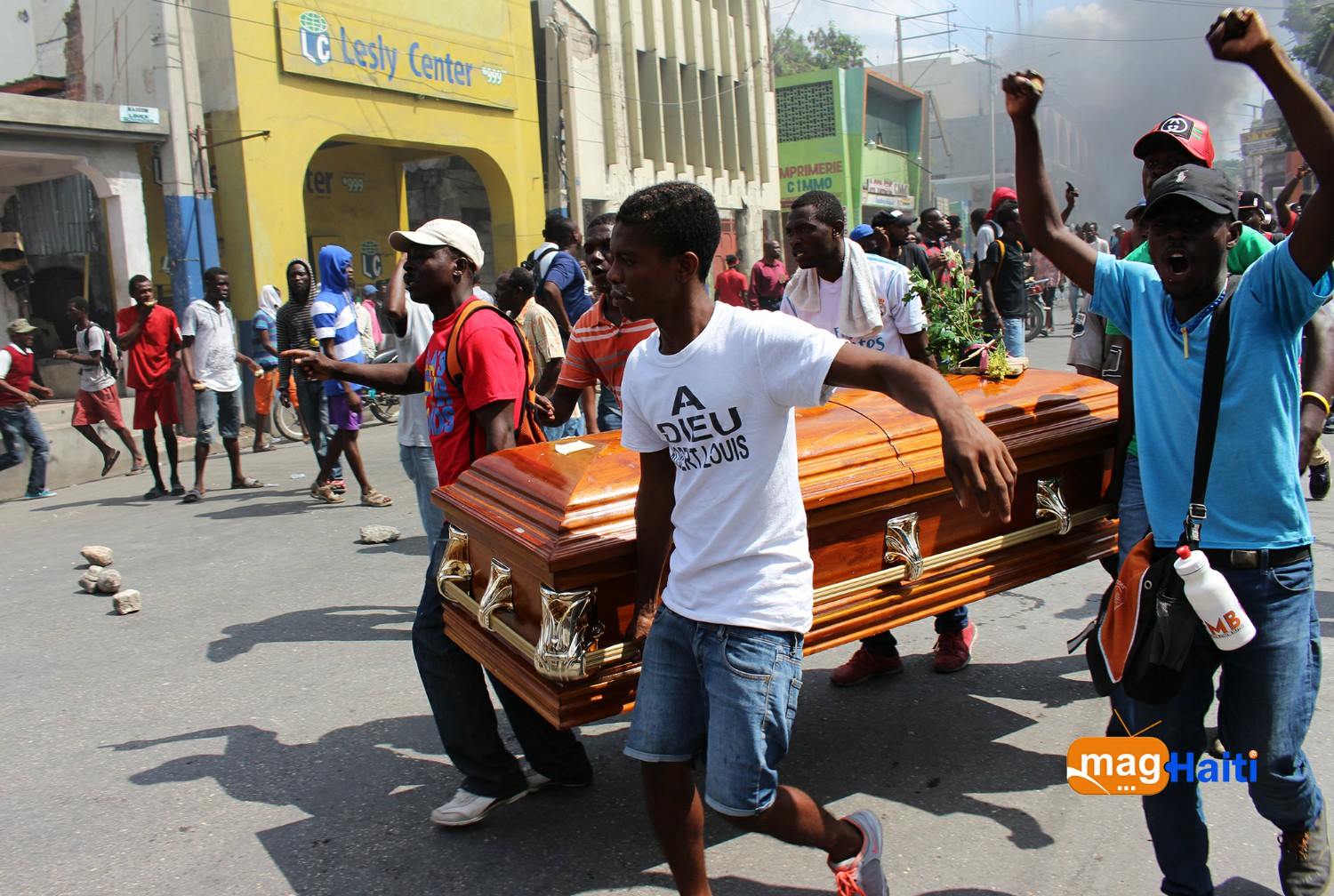 When it was learned that at least two people were killed by police bullets outside the church, the mourners marched with the caskets down the hill to the center of town.
On Oct. 31, hundreds of mourners gathered at Our Lady of Perpetual Help church in Port-au-Prince’s Belair neighborhood for the funeral of six of the seven protestors killed by police during the massive Oct. 17 march against the plundering of hundreds of millions of dollars from the Venezuela-provided PetroCaribe fund.
Saturday, October 20, 2018
Black Internationalism and the Colonial Challenges Facing Haiti and Venezuela
Jeanette Charles - Haiti Action Committee
“Haiti has no debt with Venezuela, just the opposite: Venezuela has a historical debt with that nation, with that people for whom we feel not pity but rather admiration, and we share their faith, their hope.” – Venezuelan President Hugo Chávez upon absolving Haiti of all financial debt in the wake of the 2010 earthquake.
After 35 years of incarceration, political prisoner and freedom fighter Oscar López Rivera was released in 2017. One of his revolutionary lessons urges us to recognize that “colonialism is the problem” we continue to face today. While he specifically referred to Puerto Rico and its colonial status, his reflection is applicable to anywhere in the world devastated by exploitation, occupation, and invasion at the hands of European colonialism and US imperialism. As such, we can examine the current and historical challenges facing both Venezuela and Haiti, as well as their complicated relationship, as cases that expose the open wounds and lasting effects of colonialism and counter-revolutionary attacks against revolutionary processes committed to liberation and the reconfiguration of global power.
Monday, October 15, 2018
Deforestation Triggered Mass Extinction of Endemic Animal Species in Haiti
Temple University College of Science and Technology
The loss of more than 99% of primary, virgin forests in Haiti is triggering an ongoing mass extinction of reptiles, amphibians, and other species. This deforestation is the main threat to species globally, more than disease, climate change or invasive species.
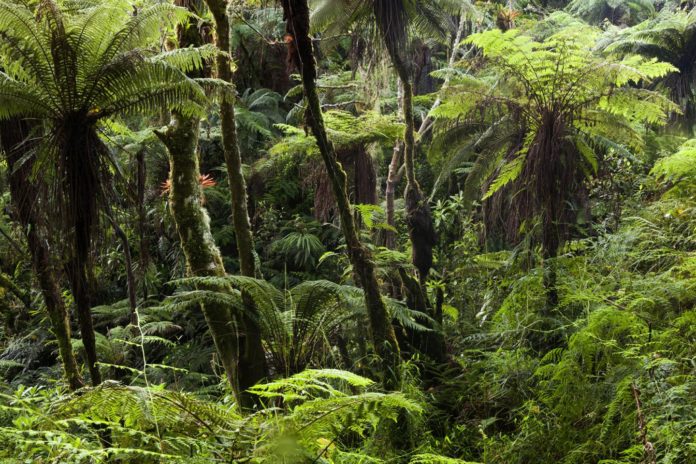 Virgin primary forest on Haiti’s Massif de la Hotte near Macaya Peak. Credit: Claudio Contreras
The loss of more than 99% of primary, virgin forests in Haiti is triggering an ongoing mass extinction of reptiles, amphibians, and other species. This deforestation is the main threat to species globally, more than disease, climate change or invasive species.
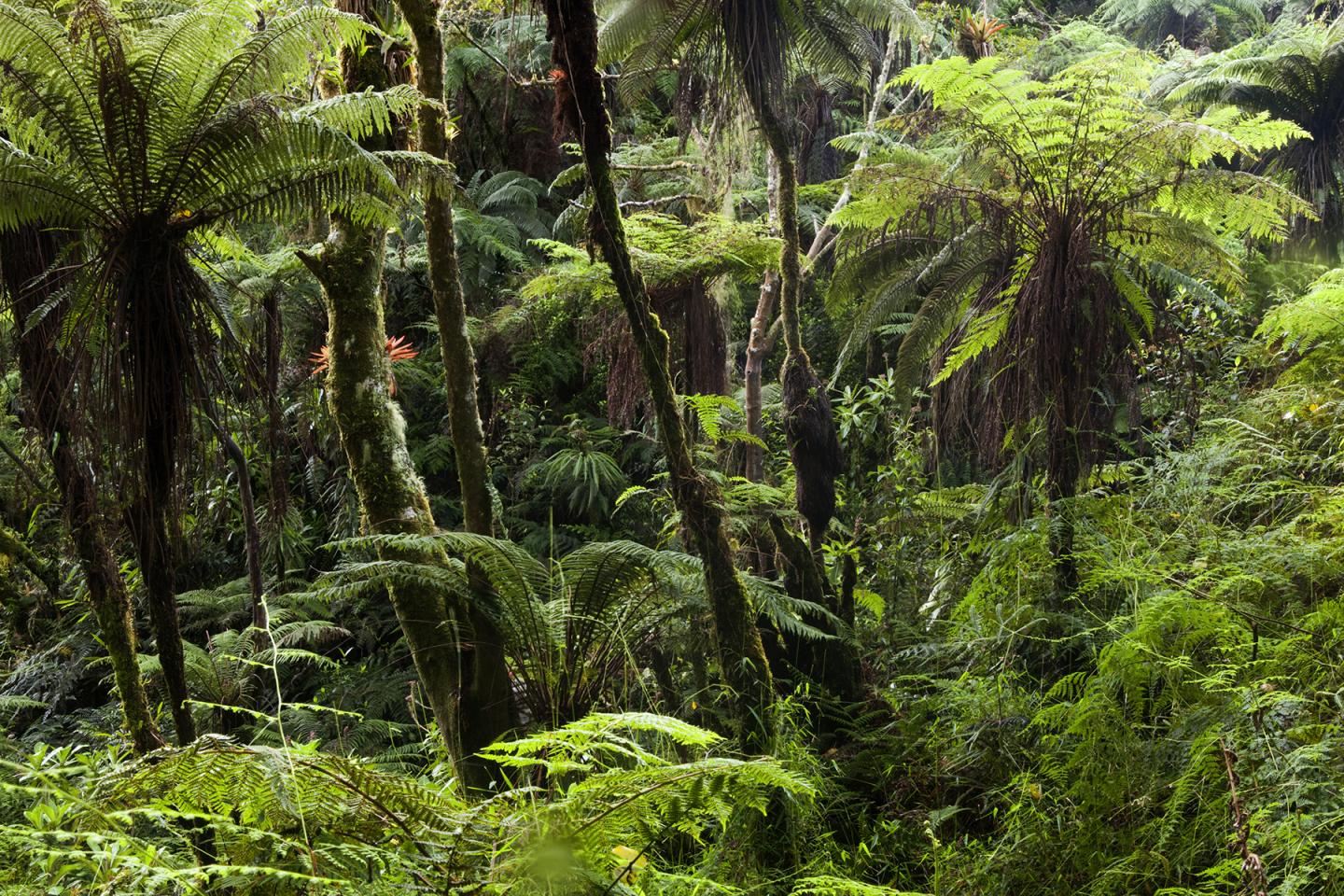 Virgin primary forest on Haiti’s Massif de la Hotte near Macaya Peak. Credit: Claudio Contreras
Sunday, October 14, 2018
Trump’s Economic Sanctions Have Cost Venezuela About $6bn Since August 2017
Joe Emersberger - Venezuelanalysis
The following piece by Canadian political analyst Joe Emersberger was written in response to a recent articleby Torino Capital Chief Economist Francisco Rodriguez.
Rodriguez is well-known as an outspoken critic of the Maduro government, but in his recent article he recognizes that Washington’s “misguided” sanctions are exacerbating falling oil production in Venezuela and as such, pejoratively affecting general living standards.
Thursday, August 23, 2018
Debate: Who Is Behind Nicaragua's Turmoil?
The Real News Network - Debate between Dr. Mary Ellsberg of George Washington University and Max Blumenthal of the Grayzone Project.
Watch all three parts here.
Wednesday, August 22, 2018
Who is Jean-Henry Céant, Haiti’s New Prime Minister Nominee?
By Kim Ives - Counterpunch
On Sun., Aug. 5, Haitian President Jovenel Moïse nominated two-time presidential candidate Jean Henry Céant, 61, leader of the Renmen Ayiti (Love Haiti) party, to be his next prime minister.
If approved by Parliament, Céant would replace Jack Guy Lafontant, who resigned on Sat., Jul. 14 as Moïse’s first prime minister following a three-day nationwide uprising from Jul. 6-8 (and then a two-day general strike), which resulted in a few deaths and dozens of businesses being burned or damaged. The rebellion against corruption, waste, and austerity, which is still smoldering, was sparked by steep fuel price hikes on gasoline (38%), diesel (47%), and kerosene (51%).
Moïse’s announced his choice over Twitter (as he had for Lafontant) after two days of protracted negotiations with parliamentarians.
Trained as a lawyer, Céant has a genial personality but is widely viewed and reviled by the Haitian people as a “land thief” (volè tè) for his conduct as a notaireor notary, who in Haiti is a cross between an accountant and lawyer supposedly safeguarding the titles to their clients’ land. Almost every notaire is accused, rightly or wrongly, of absconding with land titles, often after their clients die.
Tuesday, August 21, 2018
Rightwing in Haiti facing criticism over corruption
Here are copies of some recent tweets criticizing the role of the Jovenel Moïse government in corruption, which had already heightened under the rightwing predecessor administration of Michel Martelly. Both of these administrations entered office under historically low-turn outs and mass voter suppression.
Residents block @moisejovenel's motorcade at Pelerin 5 in PAP, #Haiti. He is accused of confiscating their land & homes to create "security buffer" for his private residence. pic.twitter.com/UdgOStEFTz— HaitiInfoProject 📡 (@HaitiInfoProj) August 22, 2018
Tuesday, August 14, 2018
On Facebook's Removal of the HaitiAnalysis Page
We are currently preparing a response to the recent removal of our page from Facebook. It is important to note that many other independent media and information outlets have faced a similar crackdown over the internet, including Venezuelanalysis.


Wednesday, May 2, 2018
Buy your ticket to join the Institute for Justice & Democracy in Haiti (IJDH) and the Bureau des Avocats Internationaux (BAI) at Gotham Comedy Club
Only 2 hours left to buy your ticket to join the Institute for Justice & Democracy in Haiti (IJDH) and the Bureau des Avocats Internationaux (BAI) at Gotham Comedy Club in New York to laugh and learn about our crucial work to advance human rights in Haiti. Headlining the event are Haitian-American comedians J-L Cauvin, Tanael Joachim and Reg Thomas and our host Vladimir Calixte, known as Haitian V.

Buy your ticket today to help us:
• Keep the pressure on the UN until it delivers on its promise to raise $400 million to eliminate cholera in Haiti and compensate the victims;
• Win justice for victims of rape while addressing the systemic issues that make women vulnerable to sexual assault; and
• Stand up for Haitians in the U.S. targeted by President Trump’s racist immigration policies.
All proceeds will benefit BAI/IJDH’s advocacy and legal work in Haiti!
Where: Gotham Comedy Club, 208 West 23rd St. Between 7th and 8th Avenues, New York, NY 10011
When: Wednesday, May 2, 2018 8:00 PM (Doors open at 7:15 PM) Ticket Price: $30.00 (plus two beverages minimum)!
Restrictions: 18 & over
Buy your ticket(s) NOW at Gotham Comedy Club website (use our promo code “jistis” to get $10 off your ticket)!
Thank you for joining us tonight in support of IJDH and BAI's work in Haiti.
Thursday, March 15, 2018
A U.N.-backed police force carried out a massacre in Haiti. The killings have been almost entirely ignored.
Jake Johnston - The Intercept
AT 5 O’CLOCK on the morning of November 13, more than 200 Haitian police officers raided the Grand Ravine area of Port-au-Prince. There was a series of loud explosions, followed by gunfire. For the next six hours, the commotion didn’t stop. The neighborhood was under siege.

Saturday, March 10, 2018
Lettre de Soutien à la Médiation au Venezuela, pas aux Sanctions
Cette lettre va être envoyée aux membres du Congrès des États-Unis, au Parlement du Canada et aux médias. Elle sera publiée dans d’autres médias, et au moins 5 de ses signataires se rendront au Venezuela pour la commémoration d’Hugo Chavez en mars, où elle sera présentée.
Lettre de Soutien à la Médiation au Venezuela, pas aux Sanctions
Nous exhortons les gouvernements des États-Unis et du Canada à retirer immédiatement leurs sanctions illégales* contre le Venezuela et à soutenir les efforts de médiation entre le gouvernement du Venezuela et les segments non violents de l’opposition politique.
Nous, les organisations et individus aux États-Unis et au Canada soussignés, soutenons des relations hémisphériques fondées sur le respect de la souveraineté de tous les peuples des Amériques. Nous sommes profondément préoccupés par l’utilisation de sanctions illégales, dont l’effet se fait le plus sentir dans les secteurs les plus pauvres et les plus marginaux de la société, pour contraindre le changement politique et économique dans une démocratie sœur. Nous constatons depuis les années 1990 que les sanctions ne servent qu’à appauvrir les familles ordinaires et à déstabiliser l’ordre public. Nous sommes incapables de citer un seul cas où les sanctions ont eu un impact positif.
Les sondages au Venezuela montrent que la grande majorité des Vénézuéliens s’oppose aux sanctions, indépendamment de leur opinion sur le gouvernement Maduro. Les sanctions ne font que compliquer les efforts déployés par le Vatican, la République dominicaine et d’autres acteurs internationaux pour négocier une résolution de la polarisation profonde au Venezuela. De plus, les sanctions sapent les efforts du gouvernement démocratiquement élu et de l’Assemblée constituante pour résoudre les problèmes économiques critiques et déterminer leur propre destin politique.
Thursday, December 14, 2017
Manne Charlemagne, Haiti's Iconic Troubadour: 1948-2017
By: Kim Ives - Haiti Liberte
Joseph Emmanuel “Manno” Charlemagne, Haiti’s most beloved and
controversial folk singer, died in a Miami Beach hospital on Dec. 10
at the age of 69, after a struggle of several months with lung cancer
which had spread to his brain.
His rich baritone voice, trenchant lyrics, and graceful melodies
inspired the generation of Haitians which rose up against the
three-decade Duvalier dictatorship in 1986. Sometimes called the
Haitian Bob Marley or Bob Dylan, Manno’s huge popularity won him
Port-au-Prince’s mayor’s office in 1995, but his lyrical idealism soon
dashed against the rocks of Haiti’s difficult political realities, and
he was all but chased from that office. In recent years, he had
withdrawn from Haiti’s political scene, except for some ill-fated
sorties which he regretted.
Born on Apr. 14, 1948, Manno was raised mostly by his aunt in
Port-au-Prince’s Carrefour neighborhood and came of age under the
brutal dictatorship of François “Papa Doc” Duvalier, who rose to power
in 1957. Both his aunt and mother were singers. His father, whose
identity Manno only learned from his mother in 1985, was also a
musician. When Manno traveled to New York to finally meet him, he
learned his father had died two months earlier.
Joseph Emmanuel “Manno” Charlemagne, Haiti’s most beloved and
controversial folk singer, died in a Miami Beach hospital on Dec. 10
at the age of 69, after a struggle of several months with lung cancer
which had spread to his brain.
His rich baritone voice, trenchant lyrics, and graceful melodies
inspired the generation of Haitians which rose up against the
three-decade Duvalier dictatorship in 1986. Sometimes called the
Haitian Bob Marley or Bob Dylan, Manno’s huge popularity won him
Port-au-Prince’s mayor’s office in 1995, but his lyrical idealism soon
dashed against the rocks of Haiti’s difficult political realities, and
he was all but chased from that office. In recent years, he had
withdrawn from Haiti’s political scene, except for some ill-fated
sorties which he regretted.
Born on Apr. 14, 1948, Manno was raised mostly by his aunt in
Port-au-Prince’s Carrefour neighborhood and came of age under the
brutal dictatorship of François “Papa Doc” Duvalier, who rose to power
in 1957. Both his aunt and mother were singers. His father, whose
identity Manno only learned from his mother in 1985, was also a
musician. When Manno traveled to New York to finally meet him, he
learned his father had died two months earlier.
Monday, November 27, 2017
Monday, November 20, 2017
Police massacre in Gran Ravin, protesting students in Cap Haitien beaten by police

– Police brutally beat teachers and students in Cap-Haitien demanding money for education, not to restore the murderous army
WARNING: GRAPHIC PHOTOS
Monday, November 6, 2017
State Department could be paving way to deport 50,000 Haitians by Thanksgiving
Miami Herald - Staff Reports
A letter from the U.S. State Department could pave the way for deporting 50,000 Haitian residents enjoying a reprieve from certain immigration rules that were waived after the 2010 earthquake, the Washington Post reported Friday.
The ruling that conditions have improved enough in Haiti and in Central America to resume normal immigration rules in those regions comes days before the Department of Homeland Security is expected to announce whether to renew the special status. Political leaders in Miami-Dade, home to the largest concentration of Haitians protected by the special status, have urged President Donald Trump to continue the waiver. But the State Department decision could be a prelude to that status being lifted.
A letter from the U.S. State Department could pave the way for deporting 50,000 Haitian residents enjoying a reprieve from certain immigration rules that were waived after the 2010 earthquake, the Washington Post reported Friday.
The ruling that conditions have improved enough in Haiti and in Central America to resume normal immigration rules in those regions comes days before the Department of Homeland Security is expected to announce whether to renew the special status. Political leaders in Miami-Dade, home to the largest concentration of Haitians protected by the special status, have urged President Donald Trump to continue the waiver. But the State Department decision could be a prelude to that status being lifted.
Statement of the Network for the Critical Study of Global Capitalism on the U.S. Blockage of Cuba
The Network for the Critical Study of Global Capitalism (NCSGC) held its Fourth Biannual Conference in Havana, Cuba on November 1-3 of 2017. The NCSGC wishes to thank our Cuban hosts and our co-sponsors from the Asociación de Historiadores Latinoamericanos y del Caribe (Association of Historians from Latin America and the Caribbean).
In these times of renewed U.S. aggression towards the Cuban people and their government, the NCSGC wishes to express its friendship and solidarity with the people and the government of Cuba. We demand that the U.S. government immediately lift its illegal economic, financial, and commercial blockage of Cuba. We add our voices to those of the 191 nations that on November 1 voted in the United Nations to condemn the blockage as a violation of international law.
Havana, Cuba
3 November 2017
Declaración de la Network for the Critical Study of Global Capitalism (Red para el Estudio Crítico del Capitalismo Global) Sobre el Bloqueo Norteamericano contra Cuba
La Network for the Critical Study of Global Capitalismo (NCSGC, Red para el Estudio Crítico del Capitalismo Global) realizó su 4ra Conferencia Bianual en La Habana, Cuba, entre el 1 y el 3 de noviembre de 2017. La NCSGC desea agradecer a nuestros anfitriones Cubanos y nuestros co-patronizadores de la Asociación de Historiadores Latinoamericanos y del Caribe.
En estos momentos de renovada agresión norteamericana contra el pueblo y el gobierno de Cuba, la NCSGC desea expresar nuestra amistad y solidaridad con el pueblo y el gobierno de Cuba. Exigimos que el gobierno norteamericano levante de inmediato, el ilegal bloqueo económico, financiero y comercial contra Cuba. Sumamos nuestras voces a las de las 191 naciones que el pasado 1 de noviembre en la Organización de las Naciones Unidas condenaron dicho bloqueo como una violación de la ley internacional.
La Habana, Cuba
3 de noviembre de
In these times of renewed U.S. aggression towards the Cuban people and their government, the NCSGC wishes to express its friendship and solidarity with the people and the government of Cuba. We demand that the U.S. government immediately lift its illegal economic, financial, and commercial blockage of Cuba. We add our voices to those of the 191 nations that on November 1 voted in the United Nations to condemn the blockage as a violation of international law.
Havana, Cuba
3 November 2017
Declaración de la Network for the Critical Study of Global Capitalism (Red para el Estudio Crítico del Capitalismo Global) Sobre el Bloqueo Norteamericano contra Cuba
La Network for the Critical Study of Global Capitalismo (NCSGC, Red para el Estudio Crítico del Capitalismo Global) realizó su 4ra Conferencia Bianual en La Habana, Cuba, entre el 1 y el 3 de noviembre de 2017. La NCSGC desea agradecer a nuestros anfitriones Cubanos y nuestros co-patronizadores de la Asociación de Historiadores Latinoamericanos y del Caribe.
En estos momentos de renovada agresión norteamericana contra el pueblo y el gobierno de Cuba, la NCSGC desea expresar nuestra amistad y solidaridad con el pueblo y el gobierno de Cuba. Exigimos que el gobierno norteamericano levante de inmediato, el ilegal bloqueo económico, financiero y comercial contra Cuba. Sumamos nuestras voces a las de las 191 naciones que el pasado 1 de noviembre en la Organización de las Naciones Unidas condenaron dicho bloqueo como una violación de la ley internacional.
La Habana, Cuba
3 de noviembre de
Sunday, November 5, 2017
How the U.S. Crippled Haiti's Domestic Rice Production
By: Leslie Mullin - Haiti Solidarity
We are all living under a system so corrupt that to ask for a
plate of rice and beans every day for every man, woman and child is to preach
revolution
– Jean Bertrand Aristide, Dignity 1990.
The basic right to eat is at the very heart of Haiti’s struggle
for democracy. Jean-Bertrand Aristide, the radical voice of Haiti’s poor,
aptly characterized slavery when he wrote, “The role of slaves was to harvest
coconuts, and the role of colonists was to eat the coconuts.” [i]
To
Aristide, those who have food and those who don’t marks the vast chasm
separating Haiti’s wealthy elite from millions of impoverished citizens:
The rich of my country, a tiny percentage of our population, sit
at a vast table covered in white damask and overflowing with good food, while
the rest of my countrymen and countrywomen are crowded under that table,
hunched over in the dirt and starving. It is a violent situation, and one day
the people under that table will rise up in righteousness, and knock the table
of privilege over, and take what rightfully belongs to them.[ii]
It’s no wonder that Haiti’s most popular party, Fanmi Lavalas,
chose the image of Haitian people seated around a dining table as its emblem,
signifying the overthrow of privilege and the right of every Haitian to share
the nation’s wealth. This is not mere symbolism. In its 1990 program, the Lavalas
party recognized the right to eat as one of three basic principles, along with
the right to work and the right of the impoverished masses to demand what is
owed them.[iii]
In a very concrete way, Aristide, Haiti’s first democratically elected
president, illustrated this commitment on the day of his February 7th, 1991
inauguration, when he invited several hundred street children to join him for
breakfast in the Palace garden.
Haiti’s hunger crisis is no accident – it is the direct result
of US economic policies imposed on rural Haiti beginning in the 1980s. The
story of how the US undermined Haiti’s domestic rice industry explains why a
nation of farmers can no longer feed itself.
After the Hurricane(s)
By: Kevin Edmonds - NACLA
Last week, a barrage of hurricanes hit the Caribbean with a frequency unrivaled in modern history. Hurricane Irma was the largest, causing the most damage to the Leeward Islands and Greater Antilles, particularly Antigua, Barbuda, Cuba, Haiti and the Virgin Islands.
After the hurricane, the media—disappointingly but unsurprisingly—crafted hyperbolic, racist headlines contrasting descriptions of the tourists as the real victims of the hurricane with locals characterized as a second life-threatening obstacle that had to be overcome. One British paper reported that “hungry locals on the islands have even started fighting each other for food and there have been reports of looters raiding hotel rooms to profit from the disaster. Tourists have broken down in tears as they have eventually been able to leave the islands devastated by the hurricane.” Several media reports upped the intensity, stating that St. Martin was “on the verge of civil war” after the hurricane passed. The reality was that people were just trying to get their hands on what they needed to survive.
Last week, a barrage of hurricanes hit the Caribbean with a frequency unrivaled in modern history. Hurricane Irma was the largest, causing the most damage to the Leeward Islands and Greater Antilles, particularly Antigua, Barbuda, Cuba, Haiti and the Virgin Islands.
After the hurricane, the media—disappointingly but unsurprisingly—crafted hyperbolic, racist headlines contrasting descriptions of the tourists as the real victims of the hurricane with locals characterized as a second life-threatening obstacle that had to be overcome. One British paper reported that “hungry locals on the islands have even started fighting each other for food and there have been reports of looters raiding hotel rooms to profit from the disaster. Tourists have broken down in tears as they have eventually been able to leave the islands devastated by the hurricane.” Several media reports upped the intensity, stating that St. Martin was “on the verge of civil war” after the hurricane passed. The reality was that people were just trying to get their hands on what they needed to survive.
Thursday, October 26, 2017
As Police Crackdown: Anti-Government Popular Uprising Continues to Grow

Massive, raucous demonstrations, sometime several times a week, have rocked Haiti’s capital, Port-au-Prince, and other provincial cities over the past two months and show no sign of subsiding, despite a lack of clear or unified leadership.
Police repression of the demonstrators has grown as their calls have morphed from denouncing a tax-laden, fee-hiking, austerity budget proposed in early September to demanding the resignation of President Jovenel Moïse, who came to power in February following controversial, anemic elections in November 2016.
In many ways the demonstrations resemble the Caracazo uprising that erupted in Venezuela in February 1989 after President Carlos Andrés Pérez’s government implemented a package (dubbed in Venezuela “ paquete”) of neoliberal economic reforms recommended by the International Monetary Fund (IMF). The measures, featuring privatizations, public employee layoffs, and tariff reductions, included slashing gas subsidies which resulted in a 30% hike in transportation costs overnight. The Caracazo revolt led to the 1992 coup d’état attempt and subsequent 1998 election of Hugo Chavez.
Similarly, Jovenel Moïse’s Washington-influenced budget proposes a host of taxes and fees on everything from drivers licenses, vehicle registrations, and passports to a 10,000 gourdes ($157US) annual tax on expatriate Haitians.
Wednesday, October 25, 2017
Washington's Warmongers Are Warming Up to Trump
Trump has traded his alt-right pals for some of the most dangerous neocons in Washington.
By Ben Norton - AlterNet Gray Zone Project
In an interview in New York City with war hawk pundit Max Boot, former CIA director David Petraeus stated in no uncertain terms that President Donald Trump’s militaristic foreign policy does not represent a significant departure from that of previous administrations, and is already quickly moving “back to the norm.”
Trump’s hardcore supporters have claimed he has been resisting the U.S. “deep state”—that is to say, the key elements of the military and national security establishment that remain the same from administration to administration. Yet just eight months into his presidency, one of the most influential faces and voices of the deep state has revealed precisely the opposite: Trump’s warmongering foreign policy is largely an intensification of the status quo, not a break from it.
In an interview in New York City with war hawk pundit Max Boot, former CIA director David Petraeus stated in no uncertain terms that President Donald Trump’s militaristic foreign policy does not represent a significant departure from that of previous administrations, and is already quickly moving “back to the norm.”
Trump’s hardcore supporters have claimed he has been resisting the U.S. “deep state”—that is to say, the key elements of the military and national security establishment that remain the same from administration to administration. Yet just eight months into his presidency, one of the most influential faces and voices of the deep state has revealed precisely the opposite: Trump’s warmongering foreign policy is largely an intensification of the status quo, not a break from it.
Monday, October 16, 2017
40 people missing as migrant vessel sinks off Haiti
AFP-
PORT-AU-PRINCE (AFP) -
Seven people were rescued Sunday by search teams scouring the seas off the island of La Tortue, Haiti's civil emergency agency said.
About 40 people are missing after a migrant vessel sunk the northern coast of Haiti, the civil emergency authorities have said.
The vessel sank after leaving La Tortue earlier in the day for Providenciales island in the northern Turks and Caicos archipelago, 200 kilometers (120 miles) to the north.
According to the survivors, three of whom were hospitalized on their return to Haiti, the vessel was carrying 50 people when it sank.
In a country where more than 60 percent of the population lives on less than $2 a day, there are frequent attempts to reach the Bahamas or Turks and Caicos illegally.
Over the past five years, thousands of young Haitians have migrated to Chile or Brazil, countries where visas are more easily obtained.
Although Haitians historically have gone to the United States, and to Florida in particular, the flow of migrants has shifted to Canada and other neighboring countries.
Since a devastating earthquake in 2010, about 60,000 Haitians have found temporary protected status in the United States.
But US President Donald Trump's administration has said that status will expire at the close of 2017.
New Documentary: IT STAYS WITH US
Check out the website for the new documentary "IT STAYS WITH US" which gives voice to the victims of violent operations conducted by the UN and Haitian National Police in Cite Soleil (between 2004 and 2007). View the full website here.


It Stays with You: Use of Force by UN Peacekeepers in Haiti
By: John Carroll, MD - Journal Star
Several days ago the UN Peacekeeping Forces (MINUSTAH) departed Haiti for the first time since 2004.
See this link which leads you to the film documentary: It Stays with You: Use of Force by UN Peacekeepers in Haiti. This film covers the “war” that occurred in Cite Soleil between MINUSTAH and Soleil gangs during the years 2005–2007. Many innocent people were caught in the middle.
This film was produced and directed by Cahal McLaughlin and Siobhan Wills.
(See this post from February, 2007.)
John A. Carroll, MD
www.haitianhearts.org
Sunday, October 15, 2017
Mass hysteria of U.S. Diplomats may explain 'sonic attacks' in Cuba, say top neurologists
By: Julian Borger and Philip Jaekl - The Guardian
Senior neurologists have suggested that a spate of mysterious ailments among US diplomats in Cuba – which has caused a diplomat rift between the two countries – could have been caused by a form of “mass hysteria” rather than sonic attacks.
The unexplained incidents have prompted the US to withdraw most of its embassy staff from Havana and expel the majority of Cuban diplomats from Washington.
The neurologists who talked to the Guardian cautioned that no proper diagnosis is possible without far more information and access to the 22 US victims, who have suffered a range of symptoms including hearing loss, tinnitus, headaches and dizziness.
Mystery of sonic weapon attacks at US embassy in Cuba deepens.
Senior neurologists have suggested that a spate of mysterious ailments among US diplomats in Cuba – which has caused a diplomat rift between the two countries – could have been caused by a form of “mass hysteria” rather than sonic attacks.
The unexplained incidents have prompted the US to withdraw most of its embassy staff from Havana and expel the majority of Cuban diplomats from Washington.
The neurologists who talked to the Guardian cautioned that no proper diagnosis is possible without far more information and access to the 22 US victims, who have suffered a range of symptoms including hearing loss, tinnitus, headaches and dizziness.
Mystery of sonic weapon attacks at US embassy in Cuba deepens.
Monday, October 2, 2017
Fanmi Lavalas Calls for General Strike
FANMI LAVALAS Press Release - September 30, 2017
September 30, 1991, September 30, 2017, 26 years have passed but the Haitian people have not forgotten and continue to show their attachment to President Aristide.
Fanmi Lavalas congratulates the hundreds of thousands of people who took to the streets in protest on September 30, 2017, to say no to political crime, economic crime, social crime that the coup d'etat government of the accused money-launderer are committing against the population. 26 years later, people are determined more than ever to confront the repressive forces that are exploiting and brutalizing them. From St. Jean Bosco church, through La Saline, St. Martin, Belair, up to Petionville, and Champs-de-Mars, demonstrators repeatedly demanded the resignation of the accused money-launderer.
Today again, the police are out to assassinate demonstrators, shooting directly at people, using tear gas and liquid skin irritant against protestors. Many were illegally arrested. The Fanmi Lavalas Political Organization condemns the violence and savage repression conducted by the police against demonstrators and demands the immediate liberation of all the people who were arrested.
The struggle will not stop. Fanmi Lavalas supports the call for a general strike on Monday October 2nd and Tuesday October 3rd. The system must be overturned. General mobilization everywhere in the country in whatever form. We Will Not Obey.
Alone we are weak,
Together we are strong,
All together we are Lavalas.
Executive Committee of Fanmi Lavalas
September 30, 1991, September 30, 2017, 26 years have passed but the Haitian people have not forgotten and continue to show their attachment to President Aristide.
Fanmi Lavalas congratulates the hundreds of thousands of people who took to the streets in protest on September 30, 2017, to say no to political crime, economic crime, social crime that the coup d'etat government of the accused money-launderer are committing against the population. 26 years later, people are determined more than ever to confront the repressive forces that are exploiting and brutalizing them. From St. Jean Bosco church, through La Saline, St. Martin, Belair, up to Petionville, and Champs-de-Mars, demonstrators repeatedly demanded the resignation of the accused money-launderer.
Today again, the police are out to assassinate demonstrators, shooting directly at people, using tear gas and liquid skin irritant against protestors. Many were illegally arrested. The Fanmi Lavalas Political Organization condemns the violence and savage repression conducted by the police against demonstrators and demands the immediate liberation of all the people who were arrested.
The struggle will not stop. Fanmi Lavalas supports the call for a general strike on Monday October 2nd and Tuesday October 3rd. The system must be overturned. General mobilization everywhere in the country in whatever form. We Will Not Obey.
Alone we are weak,
Together we are strong,
All together we are Lavalas.
Executive Committee of Fanmi Lavalas
Wednesday, September 20, 2017
Breaking News!! General Strike in Haiti
Videos from Twitter Feed of: Haiti Information Project

Protests in Port-au-Prince

Protests in Port-au-Prince
More scenes from yesterday's anti-govt protests in #Haiti. A nationwide general strike has been called for Sept.18. pic.twitter.com/uKYCZK0Pxl— HaitiInfoProject (@HaitiInfoProj) September 14, 2017
Anti-govt protests in PAP, #Haiti today demanding resignation of president @moisejovenel pic.twitter.com/aEKIZGMEn8— HaitiInfoProject (@HaitiInfoProj) September 20, 2017
Anti-govt protests in PAP, #Haiti today as reported by Wendy Lerisse. pic.twitter.com/9qTREBqQ81— HaitiInfoProject (@HaitiInfoProj) September 20, 2017
Haiti: A transport strike over tax increases on fuel, alcohol and cigarettes has shut down most of Haiti. 19-09-2017 pic.twitter.com/587sXoIeIZ— Rowan Van Dijk (@Lastkombo) September 19, 2017
Protests in Les CayesSchool kids cheer 4 anti-govt protests yesterday in #Haiti. A nationwide general strike has been called 4 Sept. 18. pic.twitter.com/oo48yxovdr— HaitiInfoProject (@HaitiInfoProj) September 15, 2017
Protests in HincheScene from today's anti-govt protests in Okay, #Haiti during first day of nationwide general strike against corruption pic.twitter.com/iP0aXvPHjc— HaitiInfoProject (@HaitiInfoProj) September 18, 2017
#Haiti: More anti-govt protests in Hinche today amid reports of attacks by #PHTK goons. pic.twitter.com/zIXDP37kGJ— HaitiInfoProject (@HaitiInfoProj) September 20, 2017
Protest in Gonaives
See article here
Tuesday, September 19, 2017
Reflections From The Red Zone (Peaceful Demonstrations)
By: Richard Morse
The concept of a peaceful demonstration is something that I'm having a hard
time wrapping my brain around.
In order to get thousands of protesting people in the streets, something
certainly must have gone wrong. I would suppose unfair economic, social or
political practices are usually the main cause of protests.
My question; is an unfair economic policy akin to violence?
When the U.S. started dumping rice and sugar into the Haitian economy, was
it economic warfare? Violence? Were the small Haitian farmers represented
at the import/export meetings or were the meetings simply attended by
Haiti's economic elites and political carpetbaggers who would be made to
benefit from the new policy?
The Haitian American Sugar Corporation has been replaced with tanks of
petroleum reserves. Do we know how that deal was made? Is that violence? Is
it compensation? How many farmers were positively affected by sudden
transition to importing sugar? Are the farmers receiving compensation?
Someone obviously is.
The concept of a peaceful demonstration is something that I'm having a hard
time wrapping my brain around.
In order to get thousands of protesting people in the streets, something
certainly must have gone wrong. I would suppose unfair economic, social or
political practices are usually the main cause of protests.
My question; is an unfair economic policy akin to violence?
When the U.S. started dumping rice and sugar into the Haitian economy, was
it economic warfare? Violence? Were the small Haitian farmers represented
at the import/export meetings or were the meetings simply attended by
Haiti's economic elites and political carpetbaggers who would be made to
benefit from the new policy?
The Haitian American Sugar Corporation has been replaced with tanks of
petroleum reserves. Do we know how that deal was made? Is that violence? Is
it compensation? How many farmers were positively affected by sudden
transition to importing sugar? Are the farmers receiving compensation?
Someone obviously is.
Subscribe to:
Posts (Atom)
Please Donate to the Haiti Emergency Relief Fund

And Support WIkiLeaks

As well as
